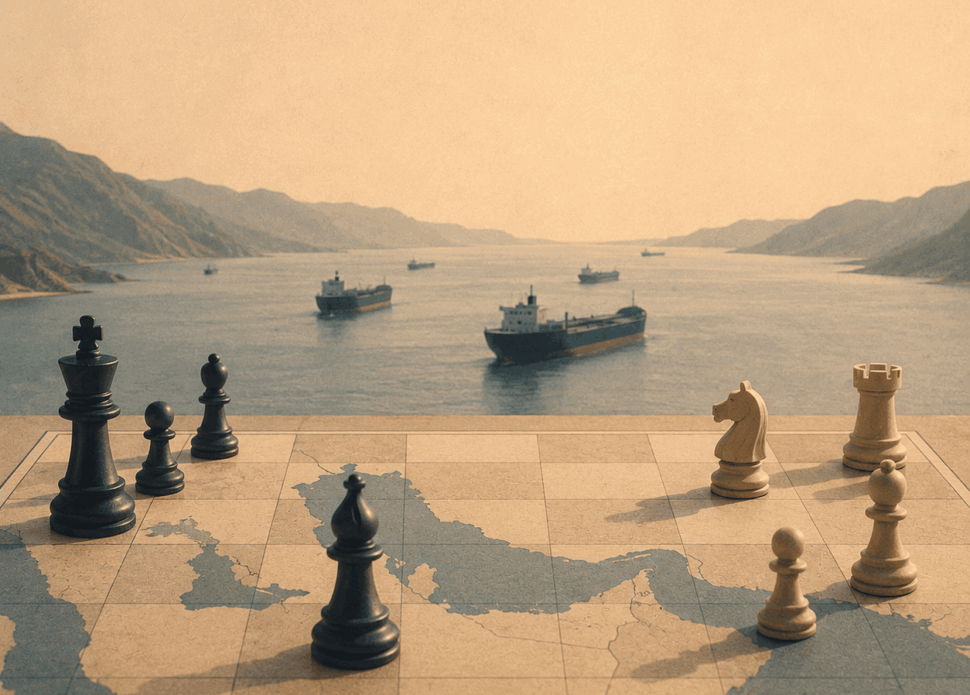
For decades, policymakers and military strategists in Tehran debated whether the Strait of Hormuz should remain merely a strategic deterrent or evolve into an active instrument of statecraft. Throughout successive crises, Iran generally refrained from employing this leverage, despite frequent political rhetoric suggesting otherwise. From Tehran’s perspective, only an extraordinary wartime environment – one perceived as threatening the very survival of the Iranian state – could justify such a transformation.
The strategic logic that now appears to dominate Iranian thinking is rooted less in economic calculation than in existential security. If Iranian decision-makers conclude that their country has entered a fundamentally different era of confrontation with the United States and Israel, they are likely to view the Strait not simply as an international waterway but as one of the remaining instruments capable of shaping the regional balance of power. In such circumstances, Tehran’s objective is not to maximize revenue or commercial influence but to preserve strategic leverage over one of the world’s most consequential maritime chokepoints.
This distinction is essential for understanding Iranian behavior. Much Western analysis tends to interpret Tehran’s Hormuz policy through the lenses of coercive diplomacy, oil markets, or freedom of navigation. Yet from Tehran’s perspective, the principal concern is the preservation of deterrence. The value of the Strait lies not in its commercial function but in its ability to influence the calculations of adversaries contemplating military pressure against Iran.
Ironically, this leverage itself is vulnerable and two currents (trends) could gradually diminish the Strait’s strategic utility.
The first danger is overuse. If Iran repeatedly threatens or disrupts maritime traffic, the international actors will inevitably accelerate investments in alternative transportation routes, pipelines, ports, and logistical corridors designed to reduce dependence on Hormuz. What initially serves as an instrument of deterrence could ultimately destroy its own value. Once global energy markets successfully diversify away from the Strait, Iran would lose one of its most significant geopolitical assets. Consequently, preserving the credibility of Hormuz as strategic leverage requires restraint as much as resolve.
The second – and arguably more immediate – concern is the deliberate effort by regional and external actors to bypass the Strait altogether. These projects that reduce dependence on Hormuz are not merely commercial or logistical endeavors; they gradually erode one of Iran’s enduring strategic advantages.
This concern becomes even more pronounced during periods of armed confrontation. In peacetime, international maritime law, established conventions, and accepted norms governing passage shape expectations of state behavior. Wartime, however, transforms strategic calculations. From Tehran’s perspective, the assumptions underlying peacetime navigation no longer adequately address existential security threats. Iranian decision-makers are therefore likely to evaluate maritime movements not simply according to peacetime regulations but according to regulations governing armed conflict that involve military risk and strategic intent.
Under such conditions, the distinction between commercial traffic and military logistics becomes increasingly blurred. Tehran may conclude that shipping routes cannot automatically be presumed politically neutral when the same maritime corridors have also facilitated the movement of military equipment, weapons systems, aircraft components, intelligence assets, or logistical support benefiting United States and its regional bases and partners that are directly or indirectly engaged in military confrontation with Iran.
This psychological and legal transformation is perhaps the least appreciated aspect of the current crisis. Before large-scale hostilities, Iran generally tolerated navigation through the Strait without interference, even though U.S. sanctions and cooperation of American partners in acquiescing to or even enforcing those sanction had drastically reduced the utility of freedom of navigation in the region for Iran as the principal coastal state. Yet wartime fundamentally alters national perceptions. From Tehran’s viewpoint, weapons, technologies, and logistical networks that later threaten Iranian territory often travel through precisely the same maritime corridors once those weapons are believed to have contributed to attacks on Iranian territory, infrastructure, military personnel, or civilians, Iranian policymakers find it increasingly difficult to separate navigation from national security.
Such experiences leave lasting effects on strategic culture. Nations emerging from existential conflict rarely return immediately to their previous security assumptions. Collective memory reshapes doctrine. Public perceptions of vulnerability become institutionalized within military planning. Civilian reactions during periods of crisis – including spontaneous efforts to protect critical infrastructure and strategic facilities – reinforce the perception that national survival requires far greater vigilance than before. In this environment, Tehran’s determination to exercise tighter oversight of the Strait reflects not only military calculation but also a broader societal conviction that future threats must be intercepted as early as possible.
This helps explain why Iran’s objectives differ fundamentally from interpretations that portray the Strait primarily as a source of economic coercion. Tehran is not principally seeking tolls, commercial rents, or short-term financial gain. Indeed, excessive commercialization of the Strait could undermine the very strategic value Iran seeks to preserve. The overriding objective is deterrence: ensuring that no adversary can exploit the maritime environment to prepare, facilitate, or sustain military pressure against Iran.
Recent developments further complicate this picture. Assuming the post-war diplomatic framework embodied in the Islamabad Memorandum of Understanding has begun to unravel following repeated military exchanges and subsequent political decisions in Washington, both Tehran and Washington appear less invested in preserving every element of the original arrangement. From the Iranian perspective, the agreement may have promised more than geopolitical realities could ultimately sustain. From the American perspective, changing political priorities and deteriorating trust have similarly reduced enthusiasm for maintaining its previous commitments.
Yet neither side appears eager for another full-scale war. Iran and the United States simultaneously demonstrate military preparedness while attempting to preserve a fragile equilibrium. Limited exchanges of fire, calibrated signaling, and carefully managed escalation have become mechanisms for communicating resolve without crossing the threshold into unrestricted conflict. Such a balance, however, is inherently unstable. Every episode of military signaling carries the possibility of miscalculation. An isolated tactical incident, a misunderstanding of intentions, or an uncontrolled escalation could rapidly overwhelm the political desire for restraint.
Within Tehran’s strategic narrative, Israel occupies a central place in this escalation dynamic. Iranian policymakers frequently argue that Israeli actions have repeatedly disrupted opportunities for de-escalation and diplomacy, encouraging broader regional confrontation between Iran and the United States. From this perspective, renewed conflict serves Israeli strategic interests by exacerbating hostilities between Washington and Tehran while weakening prospects for a stable regional security architecture. This remains an important element of Iran’s interpretation of recent regional events and therefore shapes its policy choices.
If lasting stability remains the objective, neither deterrence nor diplomacy alone will suffice. The two must reinforce one another. The immediate priority should be preventing incidents from escalating into uncontrolled military confrontation while simultaneously accelerating direct diplomatic engagement between Tehran and Washington. Sustaining dialogue during periods of tension is considerably more difficult than initiating it during moments of calm, yet it is precisely under conditions of crisis that communication becomes strategically indispensable.
Negotiations would also benefit from a greater institutional structure. Rather than attempting to resolve every dispute simultaneously, outstanding issues should be organized into three distinct categories. The first should encompass agreements that have already been reached and simply require faithful implementation. The second should consist of technical disputes suitable for sustained expert-level negotiations insulated from political confrontation. The third should contain the most politically sensitive questions, where progress will necessarily be gradual and contingent upon reciprocal demonstrations of good faith and confidence-building.
Finally, any future diplomatic architecture would require a credible mechanism for assessing compliance. A group of mutually accepted mediators could evolve beyond the traditional role of facilitator and instead function as an independent arbitral body capable of evaluating alleged violations, monitoring implementation, and providing impartial assessments of contested behavior. Such an institution would not eliminate strategic rivalry, but it could significantly reduce the risks of misperception, reciprocal accusations, and inadvertent escalation.
Ultimately, the future of the Strait of Hormuz will be determined less by legal arguments than by strategic perceptions. As long as Tehran continues to interpret the Strait through the lens of existential security rather than commercial navigation, its policies will reflect a logic fundamentally different from that assumed by many outside observers. Without understanding this logic, efforts to preserve stability in one of the world’s most strategically significant waterways are unlikely to succeed.