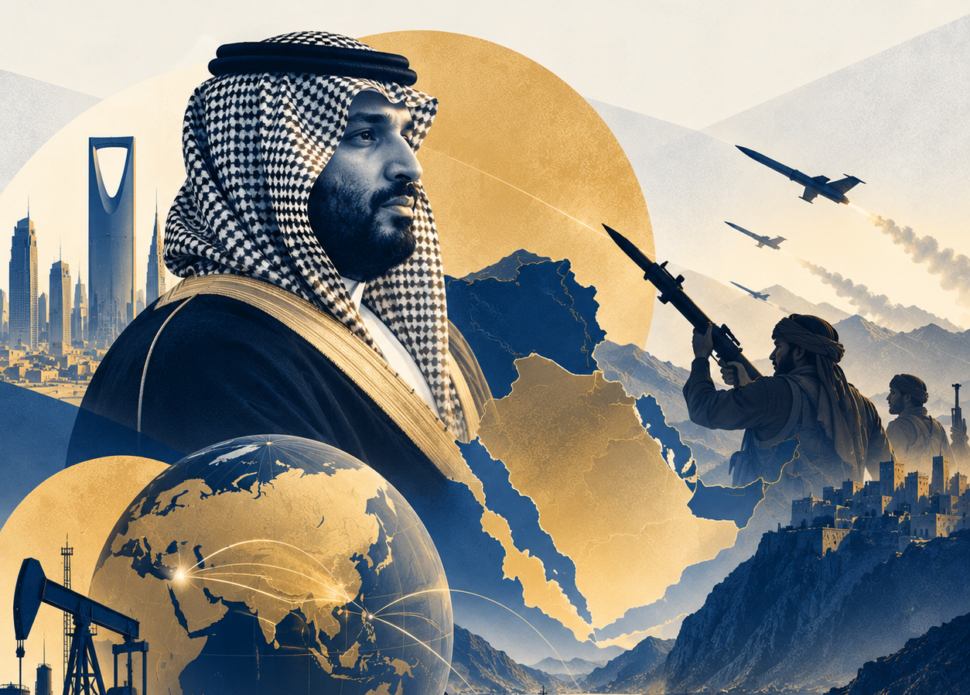
The Kingdom of Saudi Arabia is currently facing an existential threat to its territorial integrity and national stability, the economic uncertainty provoked by the Israelian-American conflict again the Islamic Republic of Iran have dragged the whole Middle East region into fringe of chaos. The recently bombing of King Khalid, the major international airport of the country, carried out by the Shia Rebel group Houthi using missiles and drones clearly showed the unpreparedness of Saudi air defences, which have clearly underestimated the ballistic capability and the determination of one of the components of the Shiite axis of resistance, capable of advancing its own agenda independent of Tehran. The criticality of the current war situation on the ground, with Ansar Allah’s recent territorial conquests, in mid-September 2026, the Houthis captured the strategic port city of Mokha (or Mocha), the rebels took control of the Dhubab area and the heights above the strait (Kahboub Mountains), positioning themselves in such a way as to threaten and dictate the conditions of passage in the global maritime corridor. Furthermore, key islands in the Red Sea, including the Hanish Islands (Greater and Lesser Hanish) and Zuqar Island are fallen under occupation of this militia force and to this territorial conquests we can add their advance inland into Taiz Province, Houthi forces have occupied the Al-Safia area and the city of Najd al Nashamah, effectively making the situation of the pro-Saudi Aden government increasingly unstable and now threatening the Saudi Kingdom all the way into its territory. While in previous years we have witnessed periodic drone strikes on the pipelines of the royal company Saudi Aramco, limiting the quantity of barrels extracted and affecting the kingdom’s finances, the killing of twelve civilians and the wounding of over three hundred at the airport now mark a significant escalation of the conflict.
The Arab alliance led by Riyadh and Abu Dhabi had already failed to defeat the Houthis by supporting the Yemeni government in 2015, but the resumption of the conflict and its escalation are indirectly linked to the prolonged crisis in the Persian Gulf and the Strait of Hormuz. The ongoing warfare showed the weakness and vulnerability of Saudi Royal Monarchy. With this offensive, the Houthis have effectively ended the truce in place since 2022 with the forces of the government recognized and supported by the Arab regional powers that relegated Ansar Allah to controlling only northern Yemen. The spread of Shiite militiamen now threatening to head towards Aden and the Indian Ocean coast has forced over 100,000 civilians from their homes.
The actual uneasy international position of the country is the result of its foreign policy firmly anchored to United States since 1970 when it was applied in the area the so called “Nixon Doctrine” aimed to turn Iran under Shah Mohammad Reza Pahlavi and Saudi Arabia as “twin pillars” of regional stability. The Us-Arab agreement signed in 1974 designed by Henry Kissinger was a key turning point for the world economic and the region and nowadays still a heavy burden for the Saudis unable to shifting and drastically reorienting its foreign policy.
Kissinger’s secret trip
In 1974, the U.S. negotiated a deal with Saudi Arabia in which the Gulf country agreed to sell oil in U.S. dollars alone. In return, the U.S. would provide military aid and security. The U.S., then under President Richard Nixon, was looking to secure global demand for the U.S. dollar following the end of the gold standard in 1971. In the wake of the 1973 oil crisis, the U.S. was motivated to solidify its own oil supply chain. Because oil was and is so fundamental to nearly every industry, the “petrodollar” became ubiquitous, and the dollar became the cornerstone of the global economy: Oil-rich countries needed a place to put their growing reserves of dollars and turned to U.S. Treasuries. Countries buying oil did so in greenbacks.
This cycle has created a currency architecture heavily favouring the U.S. dollar that has persisted for more than 50 years. Saudi Arabia, as well as Qatar, Oman, Bahrain, and the United Arab Emirates, require an estimated $800 billion in supporting reserves as a result of having their currencies pegged to the U.S. dollar. The Gulf Cooperation Council sovereign wealth funds have more than $2 trillion invested in U.S. assets. According to economists, Gulf countries have been quietly diversifying their trade partners for years prior to the current conflict, trading oil outside the U.S. dollar and therefore definitionally destroying the principle of the petrodollar as the exclusive currency for trading oil. EBC Financial Group analyst Michael Harris wrote in a note that the dollar’s share of global foreign exchange reserves has reached a 25-year low, falling from 71% in 1999 to roughly 57% today.
Signs point to China being the big winner of a de-dollarization push. In 2024, Saudi Arabia did not formally renew its commitment to pricing oil exclusively with dollars. While the 1974 agreement was never a formal obligation and its secretive nature leaves question marks about whether it resulted in a policy change, Saudi Arabia has still made moves to diversify its trade partners. In 2023, the Kingdom and China signed a $7 billion currency swap agreement. The central bank of Saudi Arabia is similarly a key participant in the mBridge digital payment platform, which allows direct currency exchanges through the blockchain.
This shift reflects a basic economic reality: China displaced the United States as Saudi Arabia’s largest oil customer. The economic gravity pointed toward yuan while the currency arrangement pointed toward dollars. The Saudis are largely still doing deals in dollars, even with China, but the door is now open.
The main problem is the multidirectional foreign policy conducted by the Kingdom that embraces parallel partnerships with the United States and U.S. strategic competitors, such as Russia and China in a deteriorate geopolitical context. The heavy Saudi strategic dependence of military supply furniture shipped by US, the presence of Prince Sultan Air Base near Al Kharj and almost 2300 soldiers deployed inside national territories plus the CIA operative stations in Ryad and military counsellors expose the reign to retaliation from Iran or Houthi without any concrete support by the American Administration. The American-Saudi military cooperation is an outdated heritage from the Petrodollar System, signed during the cold war, in which was stated that in return for ensuring oil flowed in dollars, the United States extended an implicit security umbrella over the Saudi royal family and its oil fields. In addition to this the prospect of Israeli-Saudi normalization in the frame of “Abraham Agreements” pushed by Jared Kushner and seeks by both Biden and Trump’s administrations clearly define the margins of movement for the Saudi royal house which, despite the 2024 rapprochement with Iran promoted by Chinese diplomacy, has not wanted or has not managed to completely disengage from its international commitments undertaken with the Anglo-Saxon world to fully embrace the multipolar world of the BRICS.
Pipeline break down and Diplomatic Isolation of Saudi Arabia
Strategically, the real damage suffered by Riyadh concerns the large energy infrastructure that crosses the Arabian Peninsula from east to west. Built half a century ago, the Saudi oil pipeline that extends into the country’s desert to reach the Red Sea has regained great importance with the Hormuz crisis. With a capacity of seven million barrels per day, it guaranteed Riyadh the ability to continue exporting crude oil in large quantities: its damage therefore also has an economic impact that is reflected in the already limited global availability of crude causing price increases everywhere with oil prices stable above one hundred dollars per barrel. The terminals in Yanbu North and Yanbu South on the Red Sea are within range of Houthi missiles and drones and in recent months have mainly fuelled the Asian economies most penalized by the war against Iran. Saudi Arabia could lose up to 4% of its crude oil supply following these attacks as it takes several weeks to restore pipelines each time. The Houthis do not appear to want to hinder commercial shipping in the Bab el Mandeb Strait, and they have announced that the only ships that will be prevented from entering are Saudi ones. Ships from any other country are free to transit. Despite Mohamed Bin Salman’s numerous calls on September 10 for Trump to attack Yemen, the requests were rejected.
Admiral Brad Cooper, commander of U.S. Central Command, has held urgent coordination meetings in Saudi Arabia where 100 or 200 American advisers are present to support the kingdom’s forces on intelligence, targeting, and satellite data, but the White House appears to want to maintain the truce with the Houthis that has been in place since May 2025. A decision that leaves Riyadh alone, which has so far not called for the activation of the new alliance signed in August in Mecca with Turkey and Pakistan, nor of the Red Sea naval defence coalition composed of 14 countries including Turkey, Pakistan, Egypt, Sudan, and Djibouti, all evidently reluctant to get involved in the endless and exhausting Yemeni war. Despite France’s statements, only the United Kingdom has shown itself willing to support the Saudi Kingdom with instructors and tanker aircraft for the in-flight refuelling of Saudi Air Force fighters.
The Mecca Mutual Defence Pact
Within two months of it being signed, Saudi Arabia, Turkey and Pakistan invoked the Mecca mutual defence pact in response to attacks by Yemen’s Houthi rebel forces.
The three countries agreed on October 5 to activate what Saudi defence minister Khalid bin Salman called collective deterrence measures against the Houthis. Islamabad and Ankara have undertaken to provide “agreed military forces and capabilities” and ensure their rapid deployment to the kingdom.
The same day this agreement was struck, Saudi-backed Yemeni government forces opened a counteroffensive, supported by 100 Saudi-led coalition jets from Arab and regional states, to push the Houthis back from the Bab al-Mandab, the strait they seized in September.
For a month it had looked as if the pact may turn out to be a hollow promise. Islamabad and Ankara issued messages of condemnation after a string of Houthi rebel attacks on the kingdom, but did little else. Analysts were talking of the alliance as a stress test for the alliance. And the question was whether Pakistan and Turkey would fail the test. So the two countries’ decision to deploy troops means that pact has now passed that stress test – but in the narrowest sense. Its members have turned up. But what they brought a shield, rather than a sword.
Pakistan’s defence minister, Khawaja Asif, announced that Pakistani and Turkish forces would play a supporting role, involved in reconnaissance, while Saudi forces do the fighting.
Pakistan was already in the kingdom in strength, with around 8,000 troops, a squadron of JF-17 fighters, drones and an HQ-9 air defence system operated by Pakistani crews. Its contribution can quickly assert itself.
Turkeys cannot. Under Article 92 of Turkey’s constitution, sending troops abroad needs parliamentary approval and, despite two months having passed, the parliament has yet to ratify the pact. Barın Kayaoğlu, a Turkish independent analyst and consultant, said a deployment of serving troops would require parliamentary approval, separately from ratification of the Mecca Pact. Existing bilateral agreements reportedly permit some technical assistance, while the unpublished pact’s implications for future authorisations remain unclear.
Ankara has drawn a public boundary around its involvement. Foreign Minister Hakan Fidan said on 8 October that military delegations were assessing Saudi needs, particularly air defence, electronic warfare, and technical support, while ruling out sending Turkish troops abroad to conduct attacks under the agreement.
Turkey is also engaged with troops in various international scenarios from Libya to Syria, has sent military instructors to Somaliland, and ongoing threats and diplomatic skirmishes with Israel inevitably distract Ankara from the Saudi-Yemeni conflict, preferring to focus its military attention on other geographical areas. The convergence between Tel Aviv and Ankara has created a geopolitical hub of convenience with multiple branches to different countries, not based on religious affinity or a concrete ideology but on realpolitik. The Turkish-Israeli magnet has projected its influence into the Turanic corridor, attracting countries such as Uzbekistan and Azerbaijan. Both Turkey and Israel supported Azerbaijan with weapons and logistics in the victorious Nagorno-Karabakh war against Armenia. Azerbaijan is home to Israel’s largest embassy in a Muslim country, and an Israeli-Azerbaijani military agreement has allowed the installation of a Mossad base in the Azerbaijani Caucasus. Both Turkey and Israel have cooperated to dethrone Bashar al-Assad’s government in Syria, supporting terrorist rebel militias, and it is precisely in Syria that the interests of these two governments could soon collide. If we add to this the Palestinian question and the mutual accusations of genocide between Netanyahu and President Erdogan, a long-term conflict between Turkey and Israel, especially if the United States were to formalize its exit from NATO, cannot be ruled out. At present massive Turkish support for Saudi Arabia within the framework of the Mecca Agreement does not seem to be a priority
The alliance has, however, begun to build institutions, appointing a retired Pakistani general, Numan Mahmud, as its first secretary general.
This matches the line Pakistan drew over Yemen once before. In April 2015, its parliament voted unanimously to stay neutral in the Saudi war against the Houthis. But it pledged to stand shoulder-to-shoulder with the kingdom if its territory or the holy cities were threatened. The statement on October 4 used almost the same terms.
The wording is deliberate. It ties Pakistan’s commitment to the one cause no Pakistani government can refuse, the defence of Islam’s holiest sites. But to nothing beyond that. Even if Pakistan’s ruling class is overwhelmingly dominated by the Sunni majority, the Asian country host one of the most important Shia Muslim minorities outside Iran roughly the 15% percent of the population, even the Pakistan’s founder, Muhammad Ali Jinnah, was born into a Shia family. Furthermore, the former Prime Minister and PTI Chairman Imran Khan is incarcerated at Adiala Jail in Rawalpindi, it is imprisonment sparked protests and civil unrest all over the countries and the tension inside the Pakistan society is not resolved; The sending of massive contingents of soldiers to support Saudi Arabia at this time of political instability and social fracture in a country largely dominated by the military and national intelligence services seems unrealistic.
The Mecca pact will not, by itself, guarantee the reopening of the Bab al-Mandab, through which about 12% of global trade passes in normal times. This will depend on Yemeni ground forces and Saudi air power.
THE BRICS Organization and the Zionist Foreign American Policy in the Middle East
The current position of the Saudi Kingdom on the international chessboard is a paradigmatic example of how sometimes multi-vector foreign policy, reluctant to take a clear position by reshaping alliances and not fully adhering to new multilateral platforms such as the BRICS+ organization, brings no concrete benefit. The traditional Saudis allies the United States and the European had openly decided to discharge the kingdom left defenceless in the face of rocket attacks from both the Islamic Republic and the Yemeni Houthis. All the Gulf countries have been exposed to reprisals, first economic-diplomatic and later military, the consequences of a war that has been implanted in the region by external stakeholders. The diplomatic work of the Saudi Foreign Ministry, which in concert with China had managed to re-establish diplomatic and trade relations with Iran, has been completely undermined. Beijing and Moscow consider Tehran a precious ally in the region, a country positioned at the heart of the logistic corridor of the Chinese Silk Road, an indispensable oil supplier for Chinese industry and reliable military partner for the Kremlin due to the substantial aid in the Ukrainian conflict. The construction of the Chabahar Port in the south-east province of Iran by the India Ports Global Limited (IPGL) is an outstanding example of the high profile of Indo-Iranian diplomatic relations and the centrality of Teheran inside the BRICS architecture. Islamabad is also tightened to China due to economic and military cooperation and these countries are mutual benefitting from multipolarity.
The Saudis’ impasse which is leading the country to a blind ally can be overcome through a prompt and rapid realignment on the international arena, the acquisition of stable and full BRICS membership could allow Ryad to disengage from American control and open a dialogue with Asian Member States of the region.
The Saudi Arabia is actually standing at vital crossroad for its existence and long term economic planification, the ceasefire and a diplomatic accommodation with the Houthis can be far more profitable for the kingdom than prolonged war with uncertain results and heavy burden for national budget. The emerging BRICS economies present Saudi Arabia with numerous trade opportunities to enhance global supply chains. The Kingdom’s goal of economic diversification can be realised by engaging with major developing economies, such as China, India, and Russia all bounded to Iran. This act will help balance its excessive dependence on the West and position its role in South-South collaboration, conversely the Western economies are shrinking and are affected by political turmoil’s. In the frame of BRICS, a multilateral neutral platform for dialogue and cooperation, not dominated or monopolized by a single leader, Saudi Arabia may seek mediation and dialogue with regional rivals to promote stability in the Middle East. In this regard, the BRICS platform can help enhance Saudi Arabia’s diplomatic cooperation with Iran, an area where the US involvement remains complex and the Israeli’s interferences harmful for the whole region. In 2023, China mediated diplomatic relations between Saudi Arabia and Iran, which had been frozen since 2016, underscoring the growing role of non-Western actors in regional conflict management. India has similarly emphasised the need to address instability in the Middle East through political and diplomatic dialogue. The mediation to set down conflict in the MENA region can only be carried out by a neutral country not directly involved, also the presences of US military basis in the Gulf Area represents a constant focus of instability and threat for mutual understanding and trades in Eurasia.
Another dimension of BRICS lies in its institutional flexibility and lack of ideological conditionalities, setting it apart from Western-led groupings. The BRICS grouping follows a principle of non-interference in the internal affairs of the state, respecting the sovereignty and independence of each member to conduct its domestic affairs. For Riyadh, these common principles are essential to pursue an autonomous foreign policy due to the fact the actual belligerent situation in which the country is fully involved is clearly the result of post-colonial Western Influence on Ryad’s government.
Deeper engagement with BRICS economies could facilitate partnerships with companies from China, India, Brazil and other emerging markets in areas including artificial intelligence, digital technologies, advanced manufacturing, renewable energy, electric vehicles, pharmaceuticals and mining; in doing so the State could diversify its economy and reduce its reliance on crude export as stated the Crown Prince Mohammed bin Salman in the strategic document Saudi Vision 2030.
For Saudi Arabia, such partnerships could complement its efforts to build domestic industrial and technological capabilities and attract international companies to establish operations in the Kingdom. The Kingdom’s geographic position also gave it a potential role in connecting BRICS economies with markets across the Middle East, Africa and Europe. BRICS countries discussed ways to facilitate cross-border payments and increase the use of national currencies in trade. Such initiatives could eventually have reduced transaction costs and made trade between Saudi companies and emerging markets easier. The de-dollarization and the use of national currency can drastically reduce the political use of the sanctions and the yoke of Western influence which tend to interfere to foreign affairs of Gulf countries.
BRICS has expanded considerably since it was established, with its members spanning Asia, Africa, the Middle East and Latin America. The bloc increasingly presented itself as a platform for the Global South and for greater representation of emerging economies in international institutions.
For Saudi Arabia, engaging with such a diverse group provided another avenue for maintaining relationships with multiple major powers at the same time. That included China, India and Russia, as well as regional partners such as the UAE and Iran, both of which were BRICS members. BRICS members negotiated differences over the Middle East, particularly concerning Iran and the UAE recalling the UN Chart, the principle of International Law and Diplomacy instead of the use of force and threat of economic sanctions as planted by US and Israeli administration.
The possible full engagement through BRICS should not be portrayed as anti-Western; rather viewed as an approach to strengthen Saudis position in a multipolar world through energy cooperation, particularly in hydrocarbon production and as an energy supplier to the global economy, and even more an alternative International Organization which may potentially counterbalance the inactivity of an outdated UN.
The Kingdom unfortunately for many decades had wrongly rely on the US for its security, intelligence cooperation, and military hardware, while also being aware of the shifting nature of US foreign policy with every new administration in the White House, the swinging positions and the permanent breaching of international law of US and its allies. At today, pursuing the permanence in a grey zone labelled or disguised under the form of multi-alignment strategy is highly risky for the Kingdom of Saudi Arabia, the unforeseen and unpredictable consequences could be the lost of national territory, the heavy economic losses or even the loss of any t of sovereignty. The golden horizon of multipolarity and the rise of new economic centres well represented inside the BRICS organization offer a solid prosperous long-term path for Saudis foreign policy if the country dares to free itself from US hegemony.