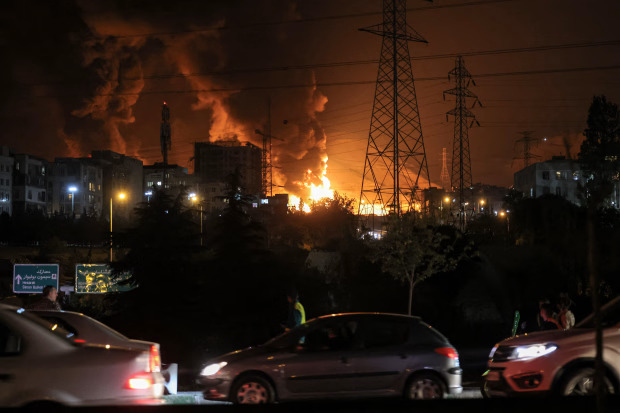
That moment appears to be approaching.
Today, an unusual convergence of interests is forming among nearly every major actor involved in the current crisis surrounding Iran. The United States, regional powers, and even global actors like China increasingly share a single objective: a cease-fire. But a fragile pause in fighting is not enough. What is needed now is a framework capable of preventing the next war before it begins.
The region has seen too many temporary truces that merely reset the clock for the next escalation.
An Exhausted Superpower
For the United States, the strategic calculus has shifted. Washington would like the war to stop—but not at its own expense. The American public has little appetite for prolonged military entanglement in another Middle Eastern conflict. Years of pressure and confrontation have produced few decisive strategic gains. Even the symbolic objective of forcing political change in Tehran has proved unrealistic. Despite the rhetoric surrounding the leadership of Ayatollah Ali Khamenei, Iran’s political system remains intact and resilient.
The costs of continued confrontation now appear to outweigh its benefits. Even figures such as Donald Trump, who once promoted maximum pressure as a success, increasingly place blame on previous policy decisions rather than presenting the confrontation with Iran as a strategic victory. Washington also understands a deeper risk: destabilizing Iran could produce chaos rather than compliance. And chaos in a country of nearly 90 million people at the center of the world’s most sensitive energy corridor could become a geopolitical trap.
Regional actors—particularly in the Persian Gulf—are also under severe pressure. Tourism has collapsed. Business confidence has eroded. Energy infrastructure and shipping routes face constant risk. Economic diversification plans across the Persian Gulf depend on stability, not
perpetual confrontation.
Publicly, many governments blame Iran for the crisis. PrivatelyA, however, they recognize a more complicated reality: most of Iran’s military actions have been reactive rather than the opening move of war. As a result, many regional governments quietly urge Washington to de-escalate, even while maintaining rhetorical pressure on Tehran. Behind closed doors, their message is simple: the region cannot sustain another prolonged confrontation.
Russia and China have largely remained on the sidelines. Neither power has provided decisive military backing to Iran. Yet both are deeply wary of dramatic changes to Iran’s political structure or a wider regional collapse. Russia benefits from elevated global oil and gas prices that conflict tends to produce. China, by contrast, suffers from the same dynamic. As the world’s largest energy importer, Beijing faces higher costs and supply uncertainty whenever tensions escalate in the Persian Gulf. For both powers, instability in Iran is a strategic risk. But neither wishes to become directly involved in the conflict.
Israel has absorbed significant internal damage during the confrontation, according to multiple reports. Yet it has also achieved one of its long-standing strategic objectives: shifting international focus away from the Israeli-Palestinian conflict and toward Iran. By reframing the region’s central security question around Tehran, Israel has successfully reshaped the diplomatic agenda. Still, even Israel cannot ignore the cumulative costs of prolonged escalation across a small and densely populated territory.
Iran, meanwhile, has paid an enormous price. Thousands of lives have been lost. Civilian and military infrastructure has suffered extensive damage. Preliminary estimates place economic losses above $50 billion, much of it affecting critical infrastructure already strained by years of sanctions. For a country whose economy has long operated under severe external pressure, rebuilding these losses will be slow and difficult. Iran therefore shares the emerging interest in a cease-fire. But Tehran’s position contains a crucial caveat.
From Iran’s perspective, a cease-fire that merely pauses the conflict would be meaningless.
The leadership in Tehran fears a familiar pattern: hostilities stop temporarily, only for the United States and Israel to return months later better prepared, more coordinated, and more determined. In that scenario, a cease-fire would serve only to give Iran’s adversaries time to recalibrate. What
Iran seeks instead is not simply the absence of war—but a structure that makes renewed aggression far more difficult.
A durable cease-fire between Iran and the United States—and by extension the wider region—could be constructed through three complementary documents:
First, the United Nations Security Council should pass a resolution committing all parties to refrain from military aggression or destabilizing actions across the region. Such a resolution would establish a legal and diplomatic baseline against renewed escalation.
Second, a regional security arrangement should be negotiated among the countries of the Persian Gulf and neighboring states—including Turkey, Iraq, and Pakistan. This framework would include mutual commitments not to attack one another and not to allow their territory, bases, or logistics to be used by third parties to launch attacks. In effect, it would create a regional non-aggression system designed to remove the operational pathways that often lead to conflict.
Third, Washington and Tehran should have a formal non-aggression pact—an agreement specifically prohibiting direct or indirect military action between the United States and Iran. This would not resolve all disagreements between the two countries. But it would establish a clear boundary preventing those disagreements from escalating into open conflict.
What makes this moment unusual is the alignment of interests: the United States wants an exit from an increasingly costly confrontation. Regional states need stability for their economies. China wants secure energy flows. Even Russia prefers controlled tension to regional collapse. Iran, despite its losses, is also open to de-escalation—provided it can trust that the pause will not simply precede the next war. Such alignment among adversaries is rare in the Middle East.
But when it occurs, it creates opportunities that should not be missed. A cease-fire may soon become inevitable. The real question is whether the international community will settle for a temporary pause—or seize the chance to construct a peace that can actually endure.